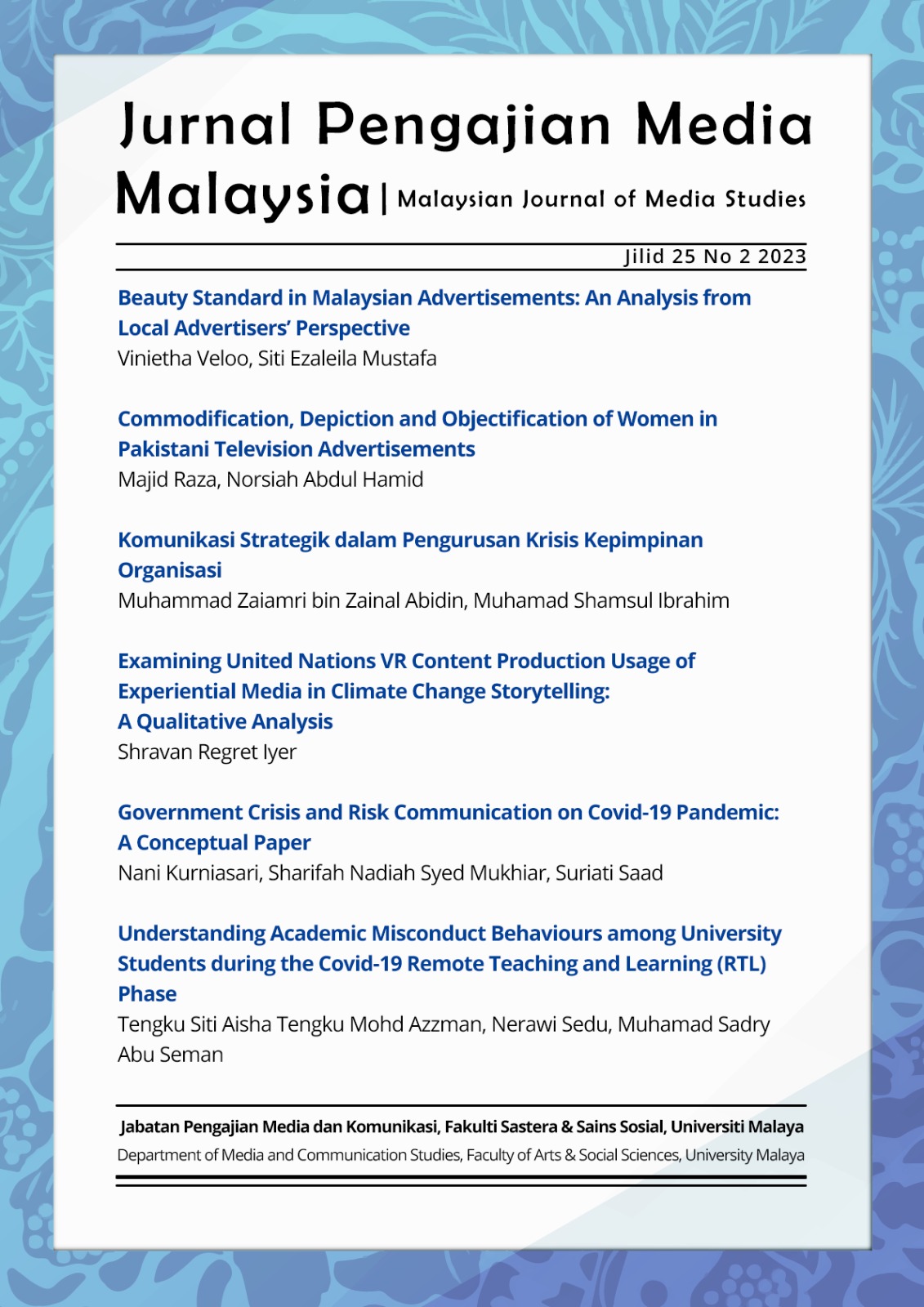
Understanding Academic Misconduct Behaviours among University Students during the Covid-19 Remote Teaching and Learning (RTL) Phase
Keywords:
Academic misconduct behavior, computer-mediated communication, online learning, religiosity, social presenceAbstract
The COVID-19 pandemic has necessitated many higher educational institutions (HEIs) to switch to online learning. In situations rife with academic uncertainties, students and staff had to adjust to this new norm. However, communication scholars established that with social presence, online learning can be enriching (Short et al., 1976). In this study, we predict that religiosity, social presence, and CMC use will reduce academic misconduct behaviors. Findings indicate that religiosity reduced academic misconduct behaviors, and perceived religiosity emerged as a significant mediator. The implication of these findings on social presence theory, and factors that may influence academic misconduct behaviors, is deliberated.
Downloads
Published
Issue
Section
License
Copyright (c) 2023 Jurnal Pengajian Media Malaysia

This work is licensed under a Creative Commons Attribution 4.0 International License.