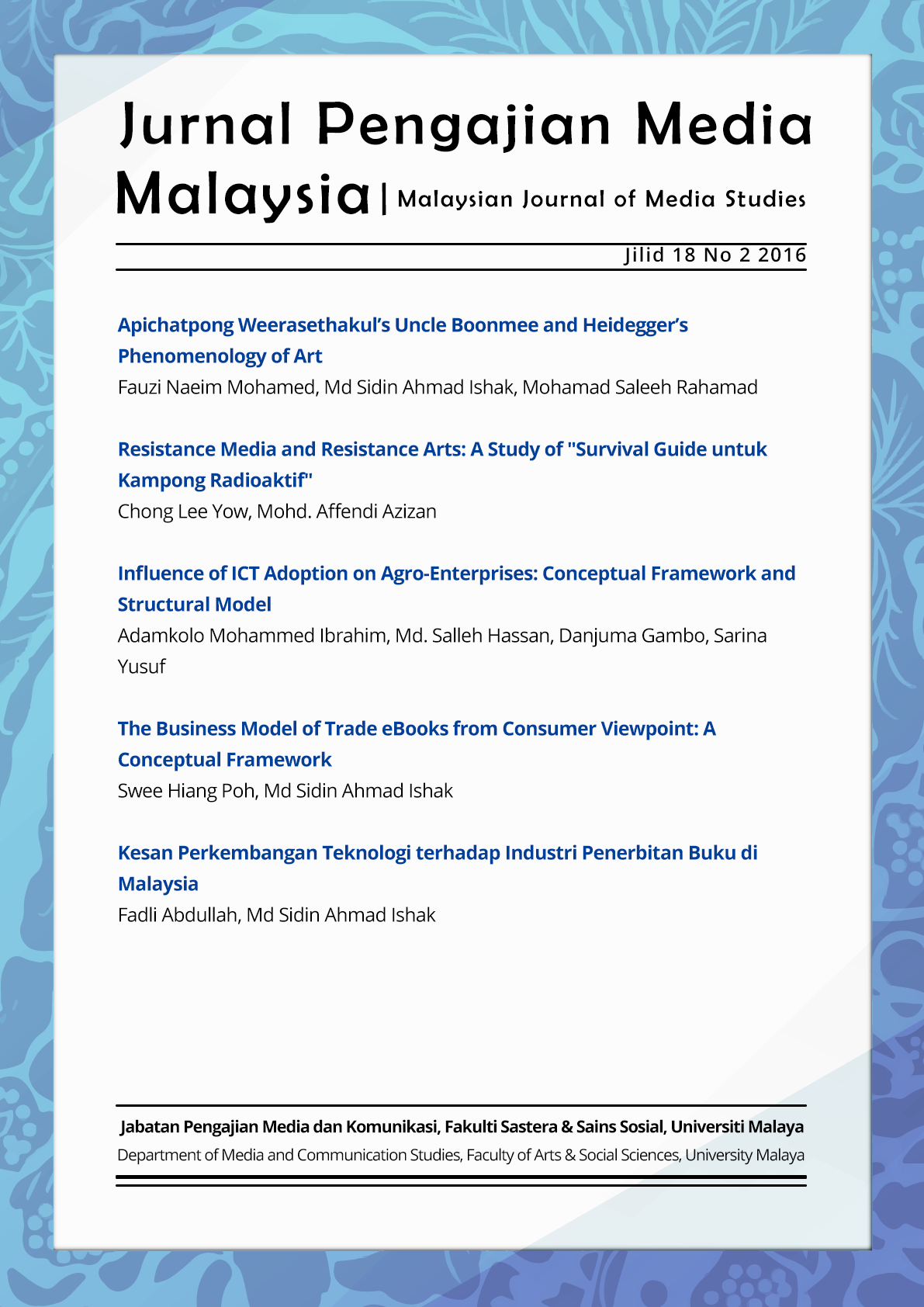
Apichatpong Weerasethakul’s Uncle Boonmee and Heidegger’s Phenomenology of Art
Keywords:
Apichatpong Weerasethakul, cinema, aesthetics, Heidegger, phenomenologyAbstract
Uncle Boonmee Who Can Recall His Past Lives (Lung Buỵmī ralụk chāti, 2010) is a quiet and mesmerizing film directed by Apichatpong Weerasethakul. This slow Thai cinema tells the story of Uncle Boonmee, who can recall his past lives. This article interprets Uncle Boonmee according to Martin Heidegger’s phenomenology of art. In Heidegger’s essay The Origin of the Work of Art (1935), he articulates that entombed in any artwork is the conflict between ‘earth’ and ‘world’. Artwork, Heidegger argues, is truth setting to work as itself. Truth, in the context of Heidegger’s vocabulary of Being, is the Greek term alétheia, which means ‘unconcealment.’ However, Heidegger’s readings in his influential essay are limited to painting, poetry and architecture but not cinema. What can cinema tells us of truth, poetically and phenomenologically? Weerasethakul’s Uncle Boonmee, with its slow, mysterious and meditative reflection on life, can perhaps give us an exemplary clue in furthering an understanding of Heidegger’s ‘conflict of the earth and the world’ in a work of art.
Downloads
Published
Issue
Section
License
Copyright (c) 2016 Department of Media Studies

This work is licensed under a Creative Commons Attribution 4.0 International License.