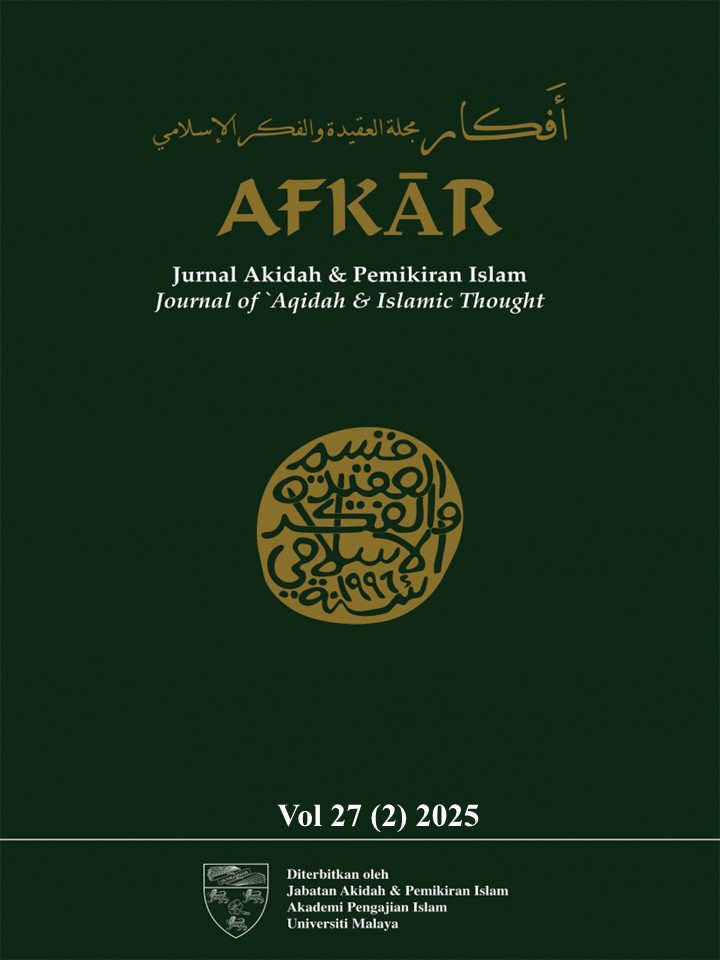
A Theological Comparative Exploration of Tolerance in Islam and Buddhism
DOI:
https://doi.org/10.22452/afkar.vol27no2.2Keywords:
Religious tolerance, religious pluralism, tasāmuḥ, kṣānti, Islam and BuddhismAbstract
Religious tolerance is a fundamental ethical principle in both Islam and Buddhism, shaping interfaith relations, governance models, and societal harmony. While both traditions emphasize compassion, patience, and mutual respect, their doctrinal foundations of tolerance differ significantly. Islamic tolerance (tasāmuḥ) is rooted in Islamic monotheism (tawḥīd), divine law (sharīʿah) and prophetic teachings (ḥadīth), where interfaith coexistence is structured within legal and ethical frameworks. The Qur’an (2:256) affirms that “there is no compulsion in religion,” and historical precedents such as the Constitution of Medina institutionalized protections for religious minorities. Conversely, Buddhist tolerance (kṣānti) arises from a nontheistic spiritual path in which moral conduct is governed by karma rather than by divine commandments. Buddhism fosters patience and forbearance as essential virtues in the Bodhisattva ideal and meditative disciplines, emphasizing inner transformation rather than legal enforcement. By analyzing both primary religious texts and contemporary sources, this study highlights common values between Islam and Buddhism, advocating for deeper interfaith dialogue and academic research on universal principles of tolerance. Understanding Islamic and Buddhist tolerance offers valuable frameworks for fostering religious harmony and coexistence in a diverse world.
References
‘Abd Allah, ‘Ali Muhammad Salih. Al-Hiwar al-Dini al-Ibrahimi fi Mizan al-Qur’an. Misr: Dar al-Salam, 2007.
Ahmad Faizuddin Ramli, Mohamed Ashath & Ahmad Moghri. “A Comparative Study on The Notion of Dialogue in Islam and Buddhism.” Afkar: Jurnal Akidah & Pemikiran Islam 25(2) (2023): 67-110.
Ahmad Faizuddin Ramli. “Pemikiran dan Sumbangan Imtiyaz Yusuf (1957-) dalam Hubungan dan Keharmonian antara Islam aan Buddhisme.” PhD thesis, Universiti Kebangsaan Malaysia, 2024.
Al-‘Asqalani, Ahmad bin ‘Ali bin Hajar. Fath al-Bari Sharh Sahih al-Bukhari. Beirut: Dar al-Fikr, 1990.
Al-Baladhuri, Ahmad Ibn Yahya. Futuh al-Buldan. Beirut: Dar wa Maktabat al-Hilal, 1988.
Al-Bukhari, Abi ‘Abd Allah Muhammad bin Isma‘il. Al-Jami‘ al-Sahih. Cairo: Maktabah al-Salafiyyah, 1979.
Alhashmi, Mariam, Naved Bakali & Rama Baroud. “Tolerance in UAE Islamic Education Textbooks.” Religions 11(8) (2020): 377.
Ibn Qayyim al-Jawziyyah, Shams al-Din Abu ‘Abd Allah Muhammad ibn Abi Bakr ibn Ayyub al-Dimashqi, Hidayat al-Hayara fi Ajwibat al-Yahud wa al-Nasara, ed. Muhammad Ahmad al-Haj. Jeddah: Dar al-Qalam, 1996.
Al-Ghazzi, Muhammad Sidqi bin Ahmad bin Muhammad al-Burno Abu al-Harith. Al-Wajiz fi Idah Qawa‘id al-Fiqh al-Kulliyyah. Beirut: Mu’assasat al-Risalah al-‘Alamiyyah, 1996.
Al-Qurtubi. Tafsir al-Qurtubi. Beirut: Dar Al-Kutub al-‘Ilmiyyah, 2010.
Al-Razi, Fakhr al-Din. Tafsir Fakhr al-Razi al-Mushtahar bi al-Tafsir al-Kabir wa Mafatih al-Ghayb. Beirut: Dar al-Fikr, 2005.
Al-Tabari, Abi Ja‘far Muhammad bin Jarir. Tafsir al-Tabari: Jamiʻ al-Bayan ʻan Ta’wil aya al-Qur’an. Cairo: Dar Hijr, 2001.
Armayanto, Harda. “Managing Religious Diversity: An Ihsan Approach.” Afkar: Jurnal Akidah & Pemikiran Islam 25(1) (2023): 99-130.
Awang, Jaffary, Ahmad Faizuddin Ramli & Zaizul Ab Rahman. “Muslim and Buddhist Encounters: Between Conflict and Harmony.” Islamiyyat: International Journal of Islamic Studies 44(1) (2022): 131-144.
Baidhawy, Zakiyuddin. “Building Harmony and Peace Through Multiculturalist Theology-Based Religious Education: An Alternative for Contemporary Indonesia.” In Peace Education and Religious Plurality. Routledge, 2013: 1-16.
Bhikkhu, Thanissaro, “The Four Noble Truths,” Access to Insight, assessed December 11, 2013. https://www.dhammatalks.org/Archive/Writings/Ebooks/FourNobleTruths230520.pdf
Brassard, Francis. Śāntideva (Bodhicaryāvatāra). Oxford: Oxford University Press, 2012.
Cakal, Ergun. “Pluralism, Tolerance and Control: On the Millet System and the Question of Minorities.” International Journal on Minority and Group Rights 27(1) (2020): 34-65.
Casewit, Yousef. “Al-Ghazali’s Virtue Ethical Theory of The Divine Names: The Theological Underpinnings of The Doctrine of Takhalluq in Al-Maqsad al-Asna.” Journal of Islamic Ethics 4(1-2) (2020): 155-200.
Diem, Werner. The Oxford English-Arabic Dictionary of Current Usage. Oxford: Oxford University Press, 1973.
Ghazali, Alwani, Nadzrah Ahmad, Khadijah Mohd Khambali, Jilani Touhami Meftah, Abdul Rahim Zumrah, and Zamrie Ibrahim. “Characteristics of the Prophetic Interfaith Dialogue: Foundation for Contemporary Interfaith Dialogue Enterprise.” Afkar: Jurnal Akidah dan Pemikiran Islam 21(2) (2019): 75-102.
Ibn Kathir, ‘Imad al-Din Abi Fida’ Isma‘il bin Kathir al-Dimasyq. Tafsir al-Qur’an al-ʻAzim. Cairo: Mu’assasah Qurtubah, 2000.
Iqtidar, Humeira. “Introduction: Tolerance in Modern Islamic Thought.” ReOrient 2(1) (2016): 5-11.
Jackson, Roger R. Karuna. “Compassion.” In Encyclopedia of Buddhism, ed. Jr. Robert E. Buswell: 320–21. New York: Thomson Gale, 2004.
Jaffary Awang. Toleransi Agama dan Perpaduan Kaum, Pandangan Intelek: Satu Observasi Ringkas. Selangor: Penerbit Universiti Kebangsaan Malaysia, 2003.
Kawamura, Leslie S. “Paramita (Perfection)”. In Encyclopedia of Buddhism, ed. Jr. Robert E. Buswe. New York: Thomson Gale, 2004.
Khadijah Mohd Khambali @ Hambali, Suraya Sintang, and Nur Farhana Abdul Rahman. “Pemaknaan Semula Toleransi Agama dalam Berta’amul.” In Islam dan Hubungan Antara Penganut Agama, eds. Azizan Baharuddin, Enizahura Abd Aziz & Mohd Amiruddin Kamarulzaidi. Kuala Lumpur: Penerbit IKIM, 2019.
Khadijah Mohd Khambali. “Kepelbagaian dan Kesatuan dalam Konteks Fiqh al-Ta’ayush di Malaysia Menurut Perspektif Pemikiran Islam.” Afkar: Jurnal Akidah & Pemikiran Islam 22(1) (2020): 73-102.
Lee, Kin Cheung & Alice Oh. “Introduction to Compassionate View Intervention: A Buddhist Counseling Technique Based on Mahāyāna Buddhist Teachings.” Journal of Spirituality in Mental Health 21(2) (2019): 132-151.
Mojahedi, Mohammad Mahdi. “Is There Toleration in Islam? Reframing a Post-Islamist Question in a Post-Secular Context.” ReOrient 2(1) (2016): 51-72.
O’Brien, Barbara, “Ksanti Paramita: Perfection of Patience,” Learn Religions, accessed March 13, 2025, https://www.learnreligions.com/ksanti-paramita-perfection-of-patience-449609
O’Sullivan, Laura & Lindsay, Nicole. “The Relationship Between Spiritual Intelligence, Resilience, and Well-Being in an Aotearoa New Zealand Sample.” Journal of Spirituality in Mental Health 25(4) (2022): 1-21.
Nur Farhana Abdul Rahman & Khadijah Mohd Khambali. “Religious Tolerance in Malaysia: Problems and Challenges.” International Journal of Islamic Thought 3 (2013): 81-91.
Sachedina, Abdulaziz. “The Qur’anic Foundation of Interreligious Tolerance.” In Fine Differences: The al-Alwani Muslim-Christian Lectures 2010-2017, ed. Richard J. Jones. Herndon: International Institute of Islamic Thought, 2020.
Shah-Kazemi, Reza. The Spirit of Tolerance in Islam. London: I.B. Tauris, 2012.
Sieradzan, Jacek. “Tolerance in Buddhism.” Idea. Studia Nad Strukturą i Rozwojem Pojęć Filozoficznych 26 (2014): 365–78.
Sioris, George A. “Buddhism in Asia: Tolerance and Syncretism.” The Tibet Journal 13(1) (1988): 20-29.
Suryadarma, Yoke & Ahmad Hifdzil Haq. “Pendidikan Akhlak Menurut Imam al-Ghazali.” At-Ta’dib 10(2) (2015): 361-381.
Syamsudin, S. “Antara Hukum Murtad dalam Islam dengan Kebebasan Beragama Menurut Hak Asasi Manusia (HAM).” El-Mashlahah 11(1) (2021): 44-59.
Tamura, Yashiro. Introduction to the Lotus Sutra. United States: Wisdom Publications, 2014.
Thero, H. Saddhatissa. Translation, The Sutta-Nipata. Richmond: Curzon Press, 1998.
Tiwary, K.N., and Sharma, N. “Buddhism and Non-violence: Exploring the Relationship between Buddhist Teachings and Conflict Resolution.” ShodhKosh: Journal of Visual and Performing Arts 5(6) (2024): 1389–1396. doi:10.29121/shodhkosh.v5.i6.2024.2332
Wakefield, Alex. “Freedom from Hatred: The Role of Khanti in Complementing the Work of International Humanitarian Law (IHL).” In Buddhism and International Humanitarian Law: 289-306. Routledge, 2023.
Wright, Dale Stuart. The Six Perfections: Buddhism and The Cultivation of Character. Oxford: Oxford University Press, 2009.
Yeh, Theresa Der-lan. “The Way to Peace: A Buddhist Perspective.” International Journal of Peace Studies 11(1) (2006): 91-112.
Yusuf, Hamza. “Generous Tolerance in Islam.” Seasons: Semiannual Journal of Zaytuna Institute 2 (2005): 26-42.
Zilio-Grandi, Ida. “The Virtue of Tolerance: Notes on The Root S-M-Ḥ in The Islamic Tradition.” Philosophy & Social Criticism 45(4) (2019): 429-437.
Downloads
Published
Issue
Section
License
Copyright (c) 2025 Afkar: Jurnal Akidah dan Pemikiran Islam

This work is licensed under a Creative Commons Attribution-NonCommercial 4.0 International License.